

What Is Softsense?
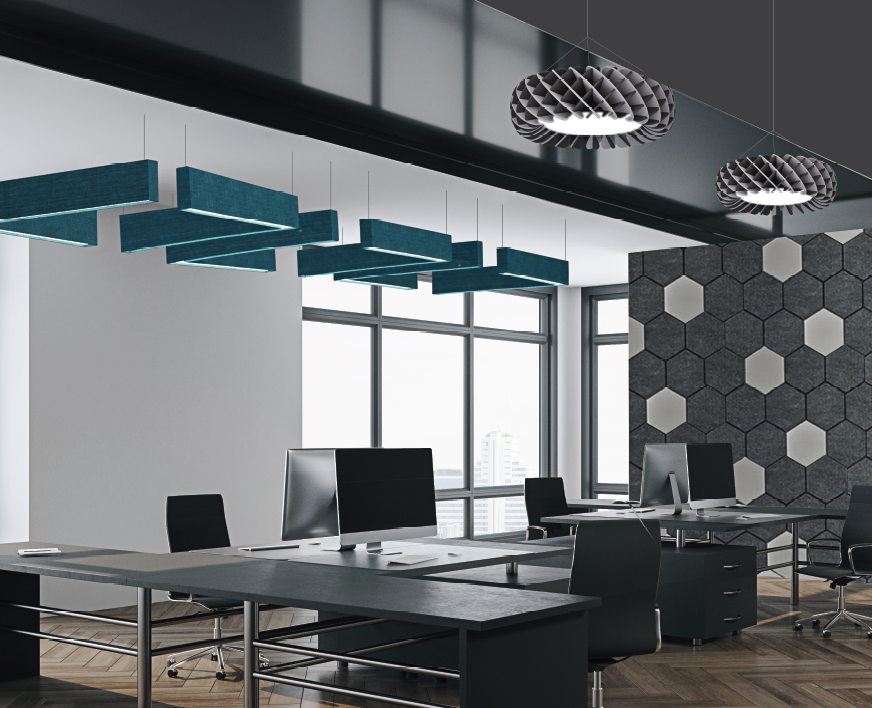
As studies increasingly show that light and room acoustics are huge factors in personal health and workplace productivity, it’s important to consider ways we can design safer human-centric spaces.
In this vein, SoftSense is a line of acoustic lighting solutions created to manage high noise level and reverberation problems in open spaces and achieve optimal illumination.
SoftSense helps mitigate the negative impacts of high-noise environments, such as distraction, hearing loss, stress, or even accidents and injuries, by reducing and absorbing noise in office spaces, healthcare and educational facilities, or community spaces like restaurants, libraries, bookstores, coffee shops, and more.
With SoftSense we create beautiful fixtures and integrated systems that anticipate both the way lighting can affect mood, circadian rhythm, and alertness, and how good acoustics contribute to productivity and health.
HOW DOES SOFTSENSE WORK?
SoftSense products focus on absorbing and blocking sound waves that cause noise.
Noise is unwanted or harmful sound caused by excessive reverberation or “echo”.
Here are some terms that help break down how sound absorption works:
- REVERBERATION TIME (RT60): the time (in seconds) it takes for the intensity of that sound to drop by 60 decibels (dB) after the sound source has stopped.
EXAMPLE: If a sound is at 160 dB and takes 4 seconds for that sound to reach 100 dB, then the RT60 of that room is 4 seconds. Knowing the reverberation time or RT60 of your room will help you determine how much sound absorption you need.
- SOUND ABSORPTION: the process of taking in sound energy when it hits different media. Lab tests use the Sound Absorption Coefficient (a) to determine how sound absorbent a material is, from 0 (no absorption) to 1 (total absorption).
EXAMPLE: a material that absorbs 45% of sound energy that strikes it will have (a) of 0.45.

- NOISE REDUCTION COEFFICIENT (NRC): To make comparing sound absorbency easy, labs test products against 4 standard frequencies: 250Hz, 500Hz, 1000Hz, and 2000Hz to get an NRC. NRC tells us how absorbent a 2D surface is.
Note: depending on the room and the furnishings in it, materials with the same NRC rating can sound different*
- SABINS (A): Sabins are a unit that measures the sound absorption of a room or 3D surface.
- RT60 = k * (V/A): where V is the total volume of a space, k is a constant, and A is the Sabin count.
The Sound Absorption Average (SAA) measures 12, 1/3 octave bands from 200 to 2500 Hz. A higher SAA means a material has better sound absorption. SAA numbers can be obtained through ASTM C423 test reports.
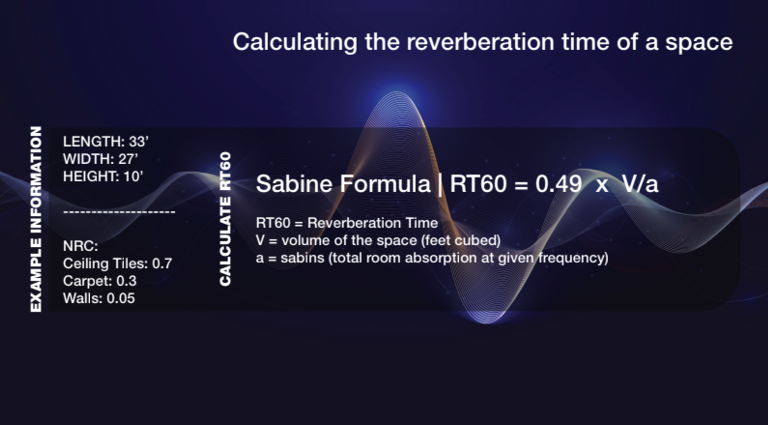

It’s important to understand that higher absorption rates do not equal good acoustics; it’s possible to have too much sound absorbency. Instead, quality acoustics are measured by how you use sound absorbency to reach the optimal reverberation time (RT60).